Boy with frog a sculpture by Charles Ray
Claudio Simeoni: Pagan Religion in art

Pagan reflections.
Italian version
Pages 53rd Venice Biennale.
The statue entitled "Boy with frog" is at Punta della dogana and has been the cause of a lot of constroversies.
The Italian newspaper "Corriere della Sera" said:
" Yes, the statue by Charles Ray says Miracco. It's beautiful but I think that leaving it there forever won't be right. It has to be an ephemeral work and stay there just during the Biennale. Anyway, why should we remove the Russian submarine from the Canal Grande? . But the mayor Massimo Cacciari reassures us about that The Boy with Frog by Charles Ray won't stay in Punta della Dogana forever, it will be removed as soon as the Biennale will end . Maybe. But in the meantime there is somebody who would like the artwork to stay. For example, a curator of the Pinault exhibition: Ray conceived it for this place says Francesco Bonami, so suggesting an hypothesis he likes. Anyway, as long as it's going to stay there it must be kept under surveillance against vandalic acts. So white and isolated, it would be an easy target. I hope it won't be, - says Miracco - and actually I don't believe so ."
The matter of discussion is the "meaning" we want to extract from this work.
One says that the statue is beautiful but should be moved; another says that it has been conceived for that place. Cacciari himself said that the statue will be removed at the end of the exhibition.
A statue isn't simply an object like any other object; it's the representation of an emotional impulse that the artist expresses through symbols. What the artist expresses is not a rational expression. It's not like in the movie "Angels & Demons", in which symbols communicated a material condition (the way of the Illuminati); here there is the communication of what the individual is in front of the world. When the artist conceives his statue (or picture), he doesn't conceive it in relation with the emotions he wants to communicate, but what he likes is what his emotions want to communicate to the world.
The statue "boy with frog" hasn't been sculpted 200 years ago. It has been made now. It's in the present time that Charles Ray liked to make it for that place and to expose it in that place. And if Charles Ray liked to make it and we liked to look at it, this is not because of its technical characteristics, but because when we looked at it the emotional breath of people get around territories as broad as the life itself.
That statue hasn't been sculpted 200 years ago. It doesn't represent symbols of thirty or fourty years ago, but today symbols, the needs of nowadays men, in the culture in which they now live and act.
Let's start from the frog: what does the frog communicate us?
The frog communicates us that it went over the tadpole stage. Predators didn't eat it while it was swimming, but it managed to become a frog. It became an adult, it has had tadpoles and now, in the hands of the boy, it's dead.
It's dead like in the tarot card: the hanged man!
The life cycle of the frog ended
|
|
What's the relation between the frog and the boy? |
|

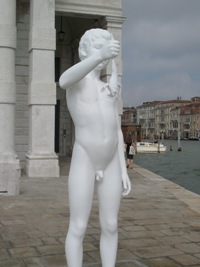
The boy is going to begin his life cycle as an adult; the frog ended its own cycle in his hands.
The boy is the tadpole of the human species and could end (or will end) his life like the frog.
This is the meaning of the statue called "boy with frog".
When the visitor looks at the statue he can't avoid to notice two things: the boy is naked and his eyes are closed (the way he tilts his head makes him looking like meditating on the frog). The visitor looking at the boy may think that the boy is meditating on his capture. On his ability.
Why is he naked and why are his eyes closed?
The visitor imagines what the boy is thinking about, how he captured the frog, what he's going to do with it.
So the boy's eyes don't communicate and his nakedness appears like something shameful that the artist could have avoided.
But this is not correct, because the visitor doesn't understand the location of the statue in the place it has been located: the visitor looks at the boy, but not at the place of the boy in the world. These two things can't be separated if we don't want to miss the meaning of the emotional communication.
Instead of looking at the "boy with frog", the visitor should try to understand the relation with the world of the boy who condemned the frog like the tarots' "hanged man".
|
|
Looking at the world through the boy's eyes. |
|


Therefore I took a picture of the statue from behind and this is the way we can understand the meaning (at least, one meaning) of the statue "boy with frog" by Charles Ray. In front of the "boy with frog" there are the space and the time: his space and his time. The space he's going to walk through and the changes he will undergo while acting in that space.
We are naked while facing our space and our time: nobody gave us the tools to do that. We are naked like the frog in the boy's hands and the boy is naked because nobody gave him clothes made with the tools with which he can face the contradictions in his existence.
Every child of the human species is a "boy with frog" who meditates on the experience he made in capturing the frog and on the many others who are bigger and smarter than him, and who stay in the space and in the time, ready to turn him in the hanged man of the tarots.
To take a photo of the boy from behind allows us to see the immense that stays in front of him: the immense that we must face during our life. And, in this immense of our life, there is no owner god and no providence, but there are many subjects that can turn us into the hanged man!
It's the meaning of modern art that emerges from symbolic categories that the christian religion and, more generally, monotheism, imposed. To represent the man in the world doesn't mean to depict the world around the man, but it means to perceive the relations of the emotional world that link every Living Being through the tension that characterize its existence. This is understanding the crucible of the emotional ensembles that shape our living in the world, in order to manage to represent them through an image that can awake the emotions of its relations in every visitor's world.
While the representation of life in the world emerges in art representation, in the Human society lacks the art of personal discipline, which can turn the emotional tornado we are inside into the individual's Power of Being.
So we like to imagine that the "boy with frog" meditates doubtfully on his frailty in a world that could turn him into a hanged man if he won't be prepared enough to face if. He's a boy thinking about the need to look for the tools, the psycho-emotional instruments to face the world in a suitable manner.
The boy with frog and father State
It's the sense of the Pagan Religion that emerges from the art. This doesn't mean that the artists call themselves Pagans, but it's because Paganism is the way we have to face life as subjects that claim their being in the world. Subjects that carry their tensions, needs, wishes in everyday life, looking to satisfy them.
While doing that, every artist becomes in fact a Pagan that frees himself from the tyranny of the shape to use the shape as a symbolic representation of his emotional perception.
I don't know if that statue will be moved from that place to others. I know that the society in which I live has lost much of the meaning of the existence to turn into a superficial "aesthetic matter". Anyway, the emotional message communicated by Charles Ray can't be separated from this interpretation. If this hasn't been true, the art would cease to be a channel of the perception, given by Father Zeus, through his daughters he had with Mnemosyne, to the Human Beings, so that they could find heroic ways to reach the Olympus of the infinite of changes.
Marghera, 09th June 2009
HOME PAGE - BACK TO PAGAN RELIGION WEBPAGES
|
Claudio Simeoni Meccanico Apprendista Stregone Guardiano dell'Anticristo Membro fondatore della Federazione Pagana Piaz.le Parmesan, 8 30175 Marghera - Venezia Tel. 3277862784 e-mail: claudiosimeoni@libero.it |
La fine dell'arroganza dei cristiani! |

Costruire la Religione Pagana è un atto di assoluta volontà
Non esiste nella società in cui viviamo una disciplina o delle regole per chi voglia costruire una Religione o, più in generale, un pensiero religioso autonomo e diverso dalla religione cattolica che domina ogni anfratto dell'esistenza umana. Chi lo fa viene visto con sospetto. Un nemico da combattere e quando viene aggredito, le Istituzioni tendono ad ignorare le aggressioni. Eppure, costruire una religione è l'unico modo per agire sulle proprie emozioni e costruire i legami fra sé stessi e il mondo in cui siamo nati.